Pico de Gallo for Tacos: A Measured Recipe
- A fresh salsa built for twelve tacos
- Ingredients
- Wash produce and set up a clean board
- Dice the tomatoes, then drain them
- Cut the onion, chile, and cilantro finely
- Mix in a deliberate order
- Keep the tortilla dry enough to bend
- Scale by weight for a smaller or larger table
- Fix the texture without chasing it in circles
- Refrigerate it; this is not a canning recipe
- A make-ahead plan that preserves texture
A fresh salsa built for twelve tacos
For pico de gallo that stays on a taco, dice 1 1/2 pounds of firm tomatoes, drain them for 10 minutes, then mix with 4 ounces of white onion, one jalapeno, 1/2 cup chopped cilantro, 2 tablespoons lime juice, and 3/4 teaspoon fine salt. Rest the mixture for 15 minutes, stir, and lift it onto tacos with a slotted spoon. The recipe makes about 3 cups, enough for twelve tacos at 1/4 cup each.
Pico de gallo is a fresh chopped salsa, not one immutable national formula. Tomato variety, chile choice, texture, and seasoning vary across cooks and places. This version has one job: bright flavor with less free liquid soaking the tortilla.
Ingredients
- 1 1/2 pounds (680 grams) firm ripe tomatoes
- 4 ounces (115 grams) white onion, about half a medium onion
- 1 jalapeno, about 1/2 ounce (15 grams)
- 1/2 cup loosely packed cilantro leaves and tender stems, about 3/4 ounce (20 grams)
- 2 tablespoons (30 milliliters) fresh lime juice
- 3/4 teaspoon (4.5 grams) fine salt
Tomatoes differ in size and water content, so weight is more reliable than “six tomatoes.” Roma or plum tomatoes are convenient because they tend to have a higher flesh-to-seed ratio, but any firm, flavorful tomato can work. Very soft tomatoes make a looser salsa and are harder to dice cleanly.
This formula yields approximately 3 cups. The taco count is arithmetic, not a promise about tomato geometry: 3 cups contains twelve 1/4-cup portions. If the produce is unusually juicy or heavily trimmed, the final volume may be lower.
Wash produce and set up a clean board
Wash hands with soap and warm water for at least 20 seconds. Rinse the tomatoes, jalapeno, cilantro, and lime under running water, then dry them with a clean towel. The FDA’s produce-safety guidance recommends running water and specifically advises against soap, detergent, and commercial produce wash.
Cut away bruised or damaged areas and discard produce that appears rotten. Keep the board, knife, bowl, and serving utensils away from raw meat, poultry, seafood, and the equipment used for them. Pico de gallo is not cooked, so cross-contamination is not corrected later by heat.
Use food-preparation gloves when cutting the jalapeno if your skin is sensitive. Keep hands away from eyes and face, and wash hands and tools thoroughly afterward. Chile heat varies from pepper to pepper; appearance does not provide an exact heat rating.
Dice the tomatoes, then drain them
Core the tomatoes and cut them into roughly 1/4-inch (6-millimeter) dice. Keep the pieces similar enough that one spoonful does not contain a tomato boulder beside onion gravel.
Put the diced tomato in a fine-mesh strainer set over a bowl. Let it drain for 10 minutes while preparing the remaining ingredients. Stir once halfway through. Do not press or squeeze; the aim is to release loose juice, not make raw tomato puree.
Save the drained tomato liquid if you will use it immediately in a soup, rice dish, or dressing. Otherwise discard it. It remains perishable and does not become pantry-stable because it passed through a strainer.
Draining before seasoning preserves control. Salt pulls additional moisture from cut tomato over time, so a mixed salsa will still become juicier as it stands. The slotted-spoon step handles that later change.
Cut the onion, chile, and cilantro finely
Dice the white onion more finely than the tomato. Small pieces spread its sharpness through the bowl instead of delivering one large raw-onion bite.
Remove the jalapeno stem. For a milder starting point, split it lengthwise and remove the pale inner ribs and seeds with a small spoon before mincing. For more heat, retain some inner tissue. The ribs contain much of the capsaicin-bearing tissue, but every pepper varies, so add only part of the minced chile first if serving people with different tolerances.
Chop the cilantro leaves and tender stems. Measure it loosely rather than compacting it into the cup. People who dislike cilantro can omit it; do not replace it automatically with a large amount of another herb and call the flavor unchanged.
Mix in a deliberate order
Put the drained tomato, onion, half to all of the minced jalapeno, and cilantro into a nonreactive bowl. Add 2 tablespoons lime juice and 3/4 teaspoon fine salt. Fold with a spoon until evenly distributed.
Cover and refrigerate for 15 minutes. Stir again, then taste with a clean spoon. Adjust only one element at a time:
- If it tastes flat but already salty, add lime juice by the teaspoon.
- If the tomato flavor is bright but underseasoned, add salt by a small pinch.
- If it needs more heat, add reserved jalapeno gradually.
- If onion dominates, add more diced and drained tomato rather than trying to erase it with lime.
Lime and salt should support the vegetables, not turn the bowl into tomato ceviche. There is no seafood here, and lime juice is not being used as a cooking or safety control.
Keep the tortilla dry enough to bend
Just before serving, stir the pico de gallo and let each spoonful drain briefly against the side of the bowl or use a slotted spoon. Add approximately 1/4 cup per taco after hot fillings are in place.
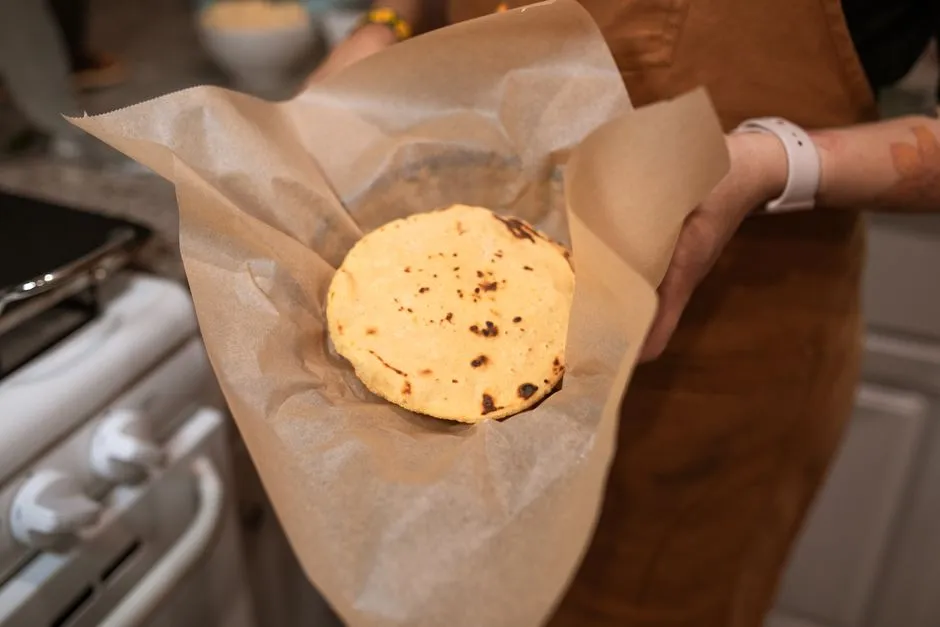
Do not place the salsa on tortillas far in advance. Tomato juice migrates into the surface while the taco waits. Our guide to warming corn tortillas explains how to heat and hold a flexible stack; the taco technique hub collects the structural details.
For crispy potato breakfast tacos, put the hot potato and egg filling down first and the cool pico de gallo on top immediately before eating. That order preserves the contrast instead of asking the tortilla to store tomato juice during brunch conversation. More complete morning recipes live in brunch recipes.
Scale by weight for a smaller or larger table
| Ingredient | Half batch | Standard batch | Double batch |
|---|---|---|---|
| Tomatoes | 340 g | 680 g | 1,360 g |
| White onion | 58 g | 115 g | 230 g |
| Jalapeno | 7.5 g | 15 g | 30 g |
| Cilantro | 10 g | 20 g | 40 g |
| Lime juice | 15 ml | 30 ml | 60 ml |
| Fine salt | 2.25 g | 4.5 g | 9 g |
The half-batch onion is rounded from 57.5 grams to a practical 58 grams. Taste remains necessary because acidity, sweetness, heat, and water content are agricultural variables, not factory settings.
For a double batch, drain tomatoes in two strainers or in several passes if crowding prevents liquid from escaping. Mix in a wide bowl so the bottom does not become much saltier than the top. Divide the finished salsa between shallow covered containers for faster chilling.
Fix the texture without chasing it in circles
| Problem | Likely cause | Practical correction |
|---|---|---|
| A puddle forms quickly | Very juicy tomatoes or no draining step | Drain the diced tomato before mixing and serve with a slotted spoon |
| Pieces fall off the taco | Dice is too large or uneven | Cut tomato to about 1/4 inch and onion smaller |
| Raw onion dominates | Onion pieces are large or ratio is high | Dice more finely or add more drained tomato |
| Salsa tastes harshly acidic | Too much lime for the tomatoes | Add more drained tomato; do not counter with random sugar before tasting |
| Heat overwhelms the bowl | Whole chile was added before testing | Start with part of the jalapeno and add in stages |
| Flavor becomes watery after chilling | Salt continues drawing tomato moisture | Stir, drain each serving, and do not add more salt before tasting solids |
Do not rescue salsa with spoiled, moldy, or slimy produce. Discard food with uncertain storage history.
Refrigerate it; this is not a canning recipe
Fresh pico de gallo requires refrigeration. Keep it covered at 40°F (4°C) or below. Refrigerate promptly and do not leave it at room temperature for more than two hours, or one hour when the surrounding temperature is above 90°F (32°C). Those are the USDA’s current leftover-handling limits.
Use refrigerated leftovers within three to four days, and sooner if quality declines. Serve with a clean utensil rather than returning a spoon that has touched plates or raw ingredients to the storage bowl.
This recipe is not tested for shelf-stable canning. Its lime quantity is chosen for flavor, not validated acidity. University of Minnesota Extension’s salsa safety guidance distinguishes refrigerated fresh salsa from tested canned formulas. Do not alter this recipe and process sealed jars at room temperature. Use a current laboratory-tested canning recipe from a recognized preservation authority without changing ingredient ratios or processing steps.
A make-ahead plan that preserves texture
For the best same-day result:
- Up to several hours ahead, wash and dry the produce.
- Dice and drain the tomatoes.
- Cut the onion and chile and refrigerate them separately in covered containers.
- Chop cilantro close to mixing time if possible.
- Combine everything 15 to 30 minutes before serving.
- Stir, taste once with a clean spoon, and keep chilled until the table is ready.
If preparing a day ahead, expect more liquid. Drain each serving rather than pouring off all liquid and seasoning again; the liquid contains some of the salt, acid, and vegetable flavor.
The useful endpoint is not “restaurant style.” It is visible and repeatable: even dice, controlled liquid, balanced seasoning, cold storage, and a spoonful that lands where the taco can carry it.